
Case Study
Design System at 3M:
Scaling Consistency Across Enterprise Products
At 3M, design consistency across products was critical but difficult to sustain at scale. I led design system efforts that aligned multiple teams, reduced fragmentation, and enabled faster, more accessible product development across enterprise platforms.
Reading time: 5–6 minutes
Role: Senior Product Designer
Year: 2019 - 2024
Platform: Enterprise Design System (3M)
The Challenge
As 3M’s digital portfolio expanded across products and teams, design quality became increasingly difficult to scale. Teams were solving similar problems in parallel, using different patterns, components, and accessibility approaches.
Without a unified design system, inconsistencies emerged across experiences, slowing delivery, increasing design and engineering overhead, and making governance difficult across a large, enterprise organization.
Constraints & Requirements
Establishing a design system at 3M required navigating a complex set of organizational, technical, and adoption-related constraints.
The system needed to support multiple product teams, each with different timelines, priorities, and levels of design maturity. At the same time, it had to align with existing brand standards, accessibility requirements, and engineering frameworks already in use across the organization.
Additional constraints included legacy patterns, distributed ownership, and the need for clear governance without slowing teams down. Any solution had to be flexible enough to encourage adoption while remaining structured enough to maintain consistency at scale.
Design Insight
It became clear that the biggest challenge wasn’t creating components, but aligning people. Teams were solving similar problems repeatedly, not because solutions didn’t exist, but because there was no shared, trusted foundation to build from.
A successful design system at this scale needed to function as both a product and a service. It had to provide clear standards and guidance while remaining flexible enough to support different product needs, team velocities, and levels of adoption.
“A design system doesn’t scale products, it scales alignment.”
Design Strategy
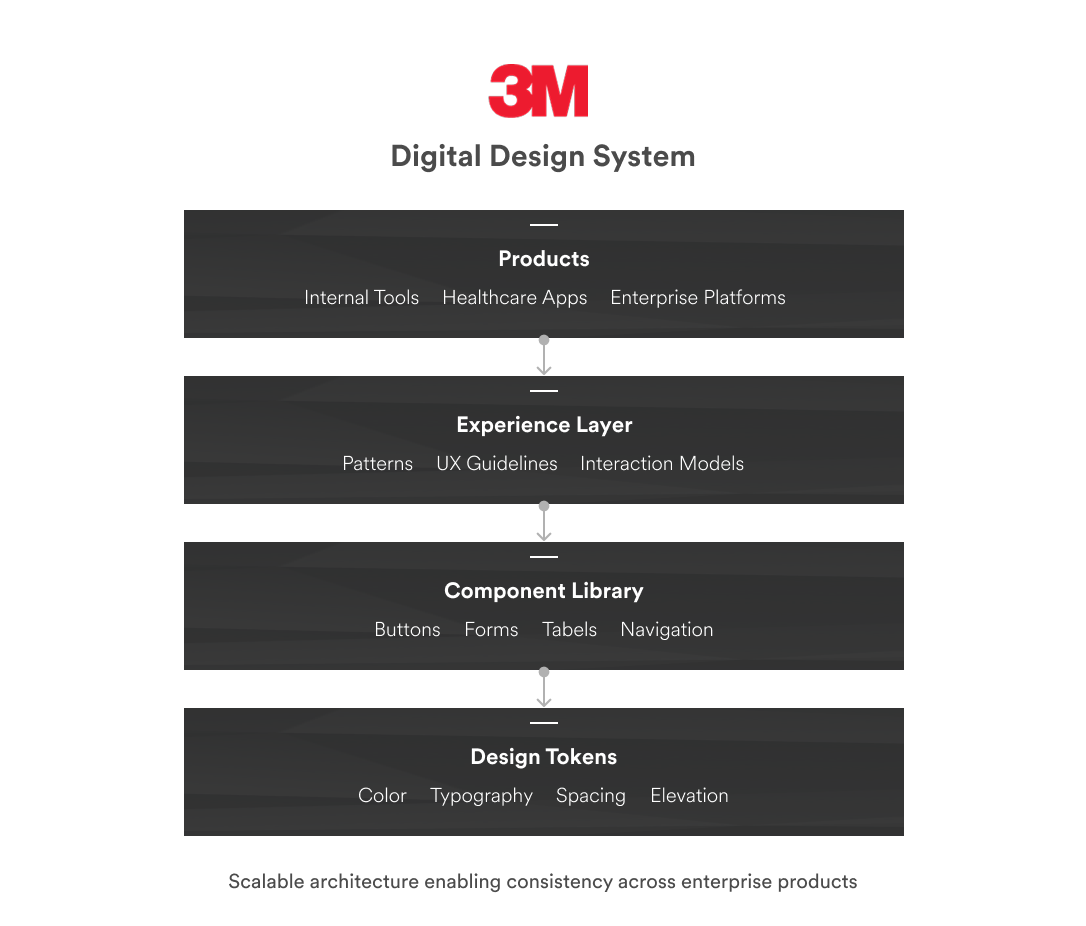
To address alignment and adoption at scale, the design system strategy focused on treating the system as a product, not a static library. The goal was to create shared foundations that teams could rely on while still allowing flexibility for product-specific needs.
The strategy centered on three key principles:
Shared foundations: Establishing core design tokens, patterns, and accessibility standards that could be reused across products.
Clear governance: Defining ownership, contribution models, and review processes without introducing unnecessary friction.
Adoption through enablement: Supporting teams with documentation, guidance, and examples to encourage trust and consistent usage over time.
Key System Changes
Based on the design strategy, the design system evolved to provide clearer foundations, stronger governance, and easier adoption across teams.
Shared Foundations
Core design tokens, components, and accessibility standards were centralized to reduce duplication and ensure consistency across products. This created a common baseline teams could build on confidently.
Clear Governance Model
Contribution and review processes were defined to clarify ownership and decision-making, helping teams understand how the system evolved without slowing delivery.
Adoption Through Enablement
Documentation, usage guidelines, and examples were designed to support teams at different levels of maturity, encouraging adoption through clarity rather than enforcement.
Outcomes & Impact
The design system helped reduce fragmentation across products by establishing shared foundations and clearer decision-making processes. Teams were able to move faster with greater confidence, spending less time re-solving common design problems.
Over time, the system supported more consistent, accessible experiences across enterprise platforms while improving collaboration between design and engineering. Most importantly, it created a scalable framework that could evolve as products and teams grew.
Key Learnings
This project reinforced that design systems succeed through adoption, not enforcement. The most effective systems are those that earn trust by making teams’ work easier, not by adding process.
It also highlighted the importance of designing governance with the same care as components. Clear ownership, contribution models, and communication are essential for sustaining consistency without slowing teams down.
This project focused on scaling alignment through systems. The next case study explores designing complex healthcare experiences with real-world constraints.